

StellarWorld Launches Lunar Cities
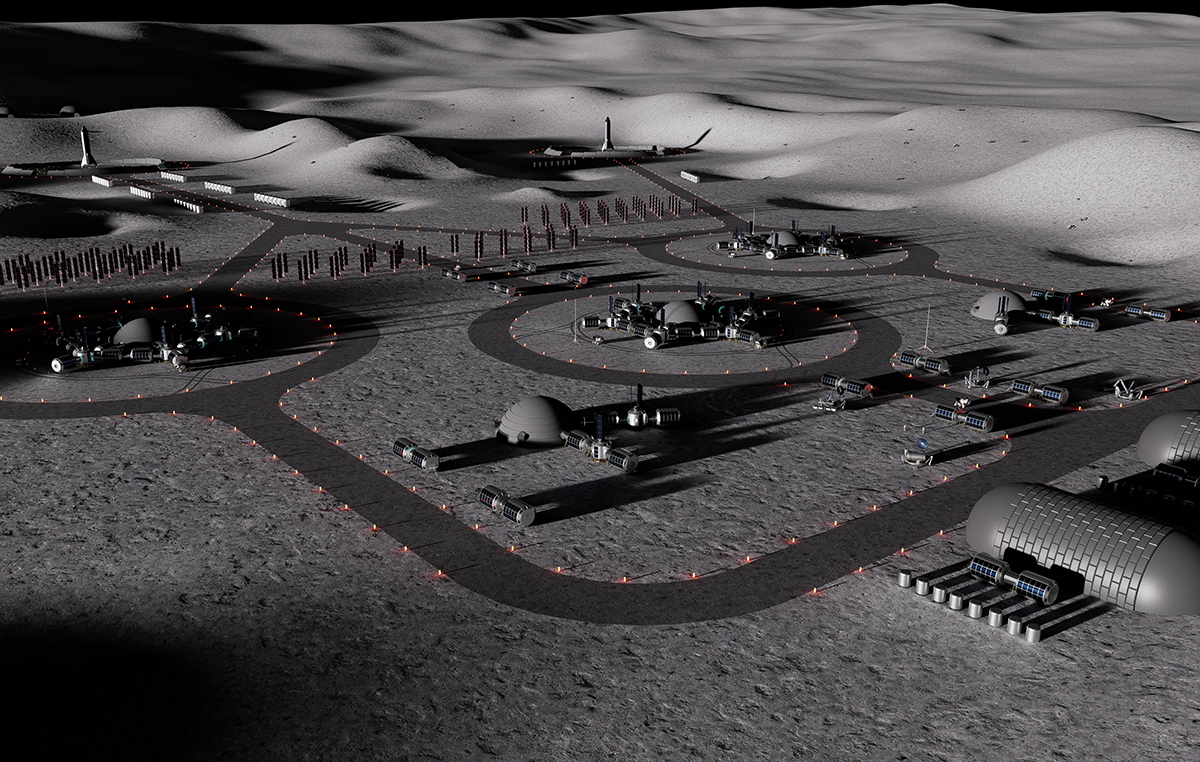
Lunar Cities District 1 Haley Spaceport and Metro Terminal
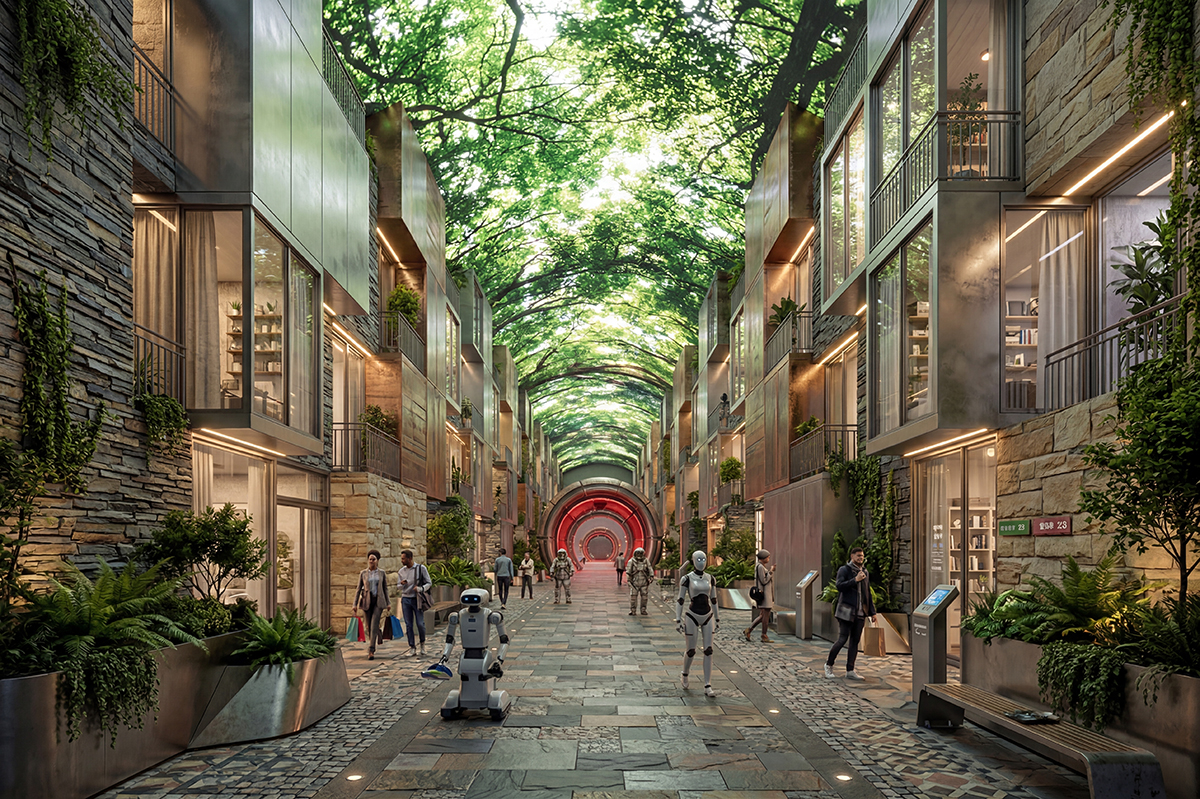
Inside Lunar Cities District 1 residential suburb, taking a walk down Ella Boulevard with shops, cafes and restaurants

Initiative opens pre-sales for constructed lunar property, invites infrastructure vendors, and calls on Artemis Accords nations to build the first Lunar City.
Launched at Space Symposium, Lunar Cities is being introduced as a structured program to help catalyze the development of a permanent human presence on the Moon through early customer engagement, industrial supply chain formation, and international participation among Artemis Accords signatory nations.
As part of today’s announcement, Lunar Cities is opening pre-sales for constructed lunar property within future developed infrastructure on the Moon. These pre-sales do not involve the sale of lunar land. Instead, they are intended to provide qualified early participants with the opportunity to secure priority access to future habitable, commercial, industrial, and data infrastructure capacity to be constructed as part of Lunar Cities.
StellarWorld is also issuing an open invitation to vendors across the lunar infrastructure stack including launch, transport, power, communications, robotics, excavation, surface systems, life support, habitat systems, and compute infrastructure to engage with Lunar Cities on future supply chain and contracting opportunities. In parallel, the company is inviting Artemis Accords signatory nations to explore participation frameworks for infrastructure, industrial capability, standards development, and long-term settlement cooperation. StellarWorld’s current materials position the lunar opportunity as having moved from aspiration toward a procurement-led industrial market, with governments buying, private companies landing, infrastructure layers forming, and geopolitical competition making the category more durable.
“Today marks the formal beginning of Lunar Cities,” said Jim Keravala, Chairman and CEO of StellarWorld. “For decades, the Moon has been treated primarily as a destination for exploration. We believe the next chapter is different. The Moon is becoming an industrial frontier and one defined by infrastructure, supply chains, paying customers, and long-term economic participation. Lunar Cities is our platform to help organize that future in a disciplined, investable, and internationally collaborative way.”
The company said the Lunar Cities program is designed around a simple principle: a permanent lunar economy will not emerge from isolated technologies alone. It will require the coordinated development of real infrastructure, real customers, and real standards. That transition is a shift from government program push to a self-sustaining end-user economy, with Lunar Cities intended to help create the critical mass of users and industrial activity required to make the broader cislunar economy durable.
Lunar Cities will initially focus on enabling five foundational infrastructure layers that StellarWorld has identified as essential to a functioning lunar city: power, manufacturing, transport, bandwidth, and compute. Those layers are no longer peripheral support systems; they are the economic and operational backbone of permanent settlement, and together define whether sustained habitation and industrial activity on the Moon can become practical at scale.
The program’s long-range development framework includes a phased progression from an initial surface base at the lunar South Pole by 2030, to a first underground district by 2040, and ultimately to large-scale settlement by 2050. Key to rapid scale is the lunar manufacturing and underground buildout of hundreds of gigawatts of super-compute AI factories underground at the Moon, eventually expanding to terawatts with associated space based solar power for the Moon and the Earth. Recent Lunar Cities planning work also reflects a design preference for purpose-built underground infrastructure over reliance on natural lava tubes, as well as a strong emphasis on standardized modular systems intended to improve interoperability, expand vendor participation, and avoid bottlenecks around any single provider or architecture.
“Permanent settlement requires more than transportation to the Moon,” commented Jeff Garzik, fellow cofounder and Chief Strategy Officer. “It requires power systems that survive the lunar night, communications and control networks that support life and industry, surface and subsurface construction capability, and the compute infrastructure to operate an increasingly autonomous environment. Our view is that the city is not a distant abstraction. It is the organizing destination that makes the entire value chain coherent.”
StellarWorld said Lunar Cities will serve as a demand-shaping and ecosystem-forming platform across multiple stakeholder groups, including future customers, sovereign partners, launch and logistics providers, energy and communications companies, robotics and construction vendors, data center and AI infrastructure developers, and long-term investors. The Moon has entered an execution phase, characterized by real budgets, real contracts, real mission hardware, and follow-on buying behavior rather than purely conceptual interest.
In keeping with that approach, Lunar Cities is beginning market engagement now before full settlement architecture is complete, in order to align early demand, technical standards, industrial partnerships, and capital formation around a common long-term development pathway. This includes future engagement on habitat and property formats, utility infrastructure, industrial district planning, customer access models, and commercial frameworks for long-duration lunar operations. This is a tapestry of models intended to bridge the gap between early infrastructure investment and the emergence of a large off-world customer base.
StellarWorld emphasized that today’s announcement is not a claim that lunar settlement has been de-risked. Rather, it is a statement that the category has matured enough to justify serious infrastructure positioning, disciplined industrial planning, and structured commercial participation. The Moon is an emerging industrial frontier in which delays and technical risk remain normal, but where sovereign anchoring, commercial procurement, private-sector execution, infrastructure layering, and growing geopolitical alignment have advanced far enough to support institution-grade engagement.
About StellarWorld:
StellarWorld is a lunar infrastructure company focused on the development of permanent lunar cities, industrial facilities and the infrastructure and supply chains required to support them. The company’s work spans surface habitation and city infrastructure, power architecture, transport and ISRU planning, communications and internet working, and lunar compute infrastructure. StellarWorld’s stated mission is to help make a permanent lunar city credible and then build it with a robust vendor supply chain.
About Lunar Cities:
Lunar Cities is a StellarWorld company established to advance the planning, commercialization, and industrial ecosystem development required for permanent human settlement on the Moon. The program is designed to support early customer participation, supply chain formation, standards development, and international collaboration around future lunar habitation, industry, and infrastructure.
Barbie Insua
StellarWorld
press@stellarworld.ai
Visit us on social media:
Other
StellarWorld Promo #1
Legal Disclaimer:
EIN Presswire provides this news content "as is" without warranty of any kind. We do not accept any responsibility or liability for the accuracy, content, images, videos, licenses, completeness, legality, or reliability of the information contained in this article. If you have any complaints or copyright issues related to this article, kindly contact the author above.
